


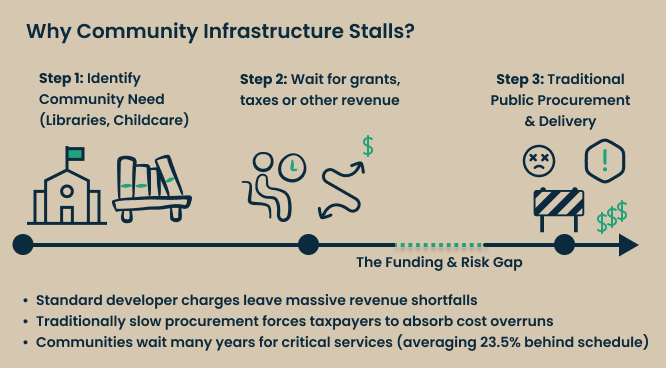
Victorian councils are facing a widening gap between community demand and what traditional funding and delivery can keep up with.
Population growth is driving demand for libraries, childcare, health facilities and other social infrastructure, but conventional funding rarely scales fast enough. Traditional public procurement also tends to be slow and structurally exposed to time and cost risk, which means even well-scoped projects can drift. The outcome is predictable: councils face the reputational heat, project teams get pulled into remediation, and communities wait longer for facilities they were promised.
Uplift-for-benefit frameworks matter because they turn planning leverage into delivered assets, not just policy intent.
In plain terms, councils grant additional development yield (extra floor area, height, or dwellings) in exchange for a defined public benefit delivered by the private sector and secured through binding agreements. Done well, this shifts councils from passive value collection into active delivery partnerships and can improve delivery certainty. Done badly, it creates years of negotiation and no facility at the end, because execution fails before the planning exchange is properly secured.
The consistent lesson from mature systems is that delivery improves when the value exchange is transparent and decision-making is time-bound.
Different jurisdictions use different mechanics, but the common success factor is reducing ambiguity in the trade and preventing feasibility disputes and scope creep from taking over. When the exchange is commercially legible and the governance pathway is disciplined, proponents can price the deal, financiers can underwrite it, and councils can defend it internally and publicly.
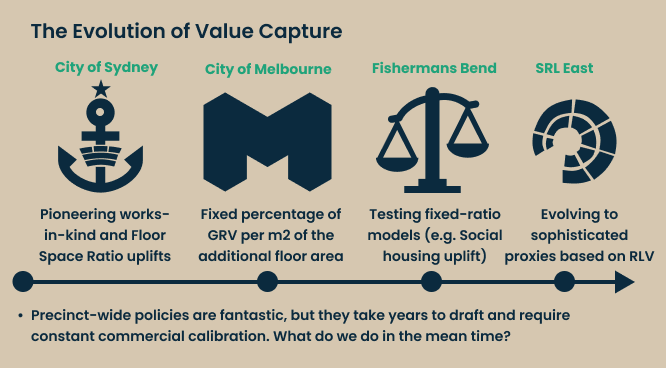
Sydney shows how a negotiated model can reward community benefit and design quality, but it demands strong internal capability and fast decisions.
The City of Sydney approach allows developers to stack incentives, unlocking additional floor area through nominated community infrastructure contributions, then applying a separate competitive design process for significant projects that can unlock a design excellence bonus. The strength is that community-dense outcomes are paired with higher design scrutiny, with a premium that can help offset the costs of superior design and the competition process. The trade-off is process load and complexity, which only works if a council has clear authority lines and can make timely decisions.
Melbourne demonstrates why a standardised value-sharing model can move faster because the maths reduces room for argument.
In the City of Melbourne’s central city model, developers can exceed a baseline Floor Area Ratio by providing a public benefit commensurate with the uplift value, calculated through a transparent methodology tied to Gross Realisation Value. The advantage is commercial legibility: both parties can quickly understand what is being traded, which reduces drawn-out disputes about what uplift is “worth” and keeps negotiations focused on deliverables. It is not frictionless, but it is predictable, and predictability is often what keeps a deal alive.
Fishermans Bend is the warning case for rigid formulas, because when feasibility moves, take-up collapses to zero.
Fixed-ratio models such as additional private dwellings per social housing unit, or density bonuses for gifting land for open space, are easy to explain but do not flex with construction costs, financing conditions, or delivery risk. When the exchange stops being commercially attractive, proponents simply do not participate, and the framework delivers nothing regardless of intent. The uncomfortable truth is that a policy can be technically neat and still fail completely if it does not create a real premium that survives real-world feasibility.
Suburban Rail Loop East-type approaches (yet to be fully tested) may be more workable due to preserving certainty and defensibility, whilst minimising disputes around assumptions.
Residual land value logic is sophisticated, but running full residual debates on every permit can trap councils and developers in endless disputes about costs, margins and assumptions. A transparent proxy method, built on independent valuations and a clear discount mechanism when calculating uplift reward, can be more practical. It helps preserve a meaningful commercial premium for the developer while giving councils a repeatable formula that is easier to defend and harder to game.
Most uplift deals fail in Victoria not because the concept is wrong, but because the pre-permit phase becomes a time-risk sink.
A familiar scenario is simple: a developer offers to deliver a 1,500 square metre library in exchange for extra floors, council agrees in principle, then the process stalls. This is rarely bad faith. It is process failure. The early stage absorbs internal stakeholder inputs, operator preferences and consultation requirements before the planning exchange is locked, so scope expands while time certainty disappears.
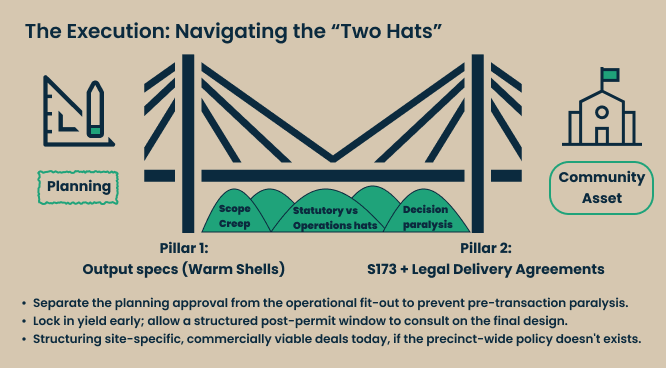
The “two hats” trap kills deals because council is both the planning authority and the future operator, and those roles collide early.
Council is simultaneously the Statutory Planning Authority granting yield and the owner-operator receiving the facility. Unless boundaries are explicit, the negotiation slides from a high-level planning exchange into operator-led design debates about adjacencies, storage, servicing, room layouts, fit-out preferences and day-to-day operational workflows. That turns the pre-permit phase into an open-ended design workshop, which is exactly the phase where uncertainty is highest and delays are most expensive.
Developers do not fear quality, but they will not carry unpriced, open-ended time risk while operational detail is debated.
Time certainty is not a preference for proponents, it is feasibility. If councils require fully resolved operational design before issuing the permit, the developer is being asked to absorb maximum uncertainty during the phase where holding costs and opportunity costs are highest, before yield is secured. If the process becomes a moving target, proponents eventually conclude the uplift is not worth the delay and they walk away, leaving councils with no uplift outcome and no public facility.
The fix is sequencing, not compromise, by locking the planning exchange early and finalising operational design later under controlled governance.
This is not about lowering standards. It is about separating what must be agreed pre-permit from what can be resolved post-permit once the project has certainty. Councils can preserve long-term quality control and still protect feasibility by locking output requirements early and deferring interior-level operational decisions to a structured, time-bound post-permit stage.
Output-based specifications keep deals commercially viable because they define measurable performance rather than subjective preferences.
To move quickly to a permit, agree the box, not the furniture. Pre-permit agreements should focus on measurable outputs such as gross floor area, floor-to-ceiling heights, structural load capacity, servicing allowances, baseline fire and acoustic performance, and accessibility compliance. A warm shell model is often the most practical expression of this: the developer delivers a high-quality shell suitable for the intended use, while bespoke operational fit-out is completed later by council or funded via a capped contribution that contains scope creep.
Phased approvals through permit conditions protect feasibility because they lock yield early while giving a realistic window to resolve detail.
Councils should avoid holding the underlying yield hostage to interior design resolution. A more workable approach is to use permit conditions that require a Community Infrastructure Delivery Plan (or equivalent) to be endorsed prior to commencement of construction, rather than prior to permit issue. This locks in the uplift early, stabilises feasibility, and creates a controlled post-permit period to resolve operational requirements properly, when incentives are aligned and the project is real.
A Delivery Agreement is essential because statutory instruments secure obligations, but they do not manage timeframes, scope boundaries, or decision accountability.
Section 173 agreements can secure obligations against the land, but they do not govern day-to-day working arrangements, review timeframes, or change control. A separate commercial Delivery Agreement should define milestones for submissions and approvals, set response windows for council as operator, establish scope boundaries, and include deemed approval mechanisms where appropriate. If council does not respond within agreed timeframes, submissions should be deemed approved to prevent well-intentioned internal processes becoming permanent delay.
Precedent risk is real, but it can be managed through site-specific, defensible transactions rather than blanket policy shifts.
Many councils hesitate because they fear that granting uplift on one site creates a municipality-wide expectation. That risk can be contained if the uplift is explicitly tied to a site-specific public benefit, secured through enforceable obligations, and justified on the facts of the location and the outcome. Delivering a Civic-Plus Hub, where childcare, health rooms, or a library is integrated into the mixed-use development via a transaction structure that can withstand scrutiny.
The pragmatic path is to prove delivery through well-governed one-off projects now, then codify later once templates and governance mature.
Most councils are not ready to publish a whole-of-municipality value-capture policy immediately, and communities cannot afford to wait. A practical approach is to structure a series of disciplined, site-specific deals that demonstrate what works, establish repeatable templates, and build internal confidence. Codification becomes easier once there is a proven pattern, not just a theoretical framework.
Estate of the Art’s role is to structure uplift deals so they can be approved quickly, secured legally, and delivered without years of pre-permit churn.
At Estate of the Art, we bridge the gap between policy intent and delivery reality by structuring site-specific uplift transactions that are defensible and commercially realistic. We support councils to negotiate bespoke Section 173 agreements that properly secure the public benefit, draft phased permit conditions that protect feasibility while preserving quality control, and establish Delivery Agreements that impose boundaries, timeframes and decision accountability.
The goal is not theory. It is one thing: a secured public benefit that gets built.
