


The 2026-27 rate cap is set at 2.75%. Current CPI is 4.6% (year to March 2026), forecast to reach 4.8%. Every Victorian council is now operating with a structural revenue gap of approximately 1.85 percentage points, compounding annually. For a mid-sized municipality, the arithmetic is unforgiving.
In 2026, local governments across Victoria are contending with a structurally constrained revenue model. A decade on from its introduction, the Fair Go Rates System has fundamentally altered municipal financial trajectories. Simultaneously, councils act as custodians of multi-million-dollar property portfolios, many of which contain ageing, underutilised, and in some cases obsolete legacy infrastructure. The intersection of these two realities (a capped revenue ceiling and escalating asset holding costs) creates a profound and expanding structural deficit.
The challenges in Victorian council asset management are rarely just financial; they are also deeply operational and political. When a council attempts to strategically reposition a physical asset occupied by a long-standing community organisation or volunteer group, fiduciary necessity collides with strong community sentiment. It is at this intersection that traditional public sector property strategies frequently stall.
The Financial Reality
To understand the root of this execution gap, empirical data provides the clearest diagnosis. The Victorian Auditor-General's Office (VAGO) 2024-25 audit of local government and the Essential Services Commission (ESC) 2025 Rate Capping Outcomes Report together document a sector operating under compounding fiscal pressure.
The VAGO 2024-25 audit revealed most councils failed to provide draft financial reports within agreed timeframes. Disclosure errors within performance statements increased by 197% compared to the prior year. Critically, the root cause of these reporting failures was identified as inaccurate, incomplete, or missing content regarding property, infrastructure assets, plant, and equipment balances.
Internal capacity is saturated by baseline compliance, and capital execution is stalling. The sector recorded a capital expenditure underspend of $820 million, representing a 19.6% shortfall from budgeted targets.
The ESC's 2025 Outcomes of Rate Capping Report explains the underlying mechanics. While the report notes that sector-wide debt remains relatively low and most councils appear to be in good financial health, the structural foundation is quietly eroding. Expenditure has grown at a faster rate than revenue over the long term. Because rate caps have frequently been set below inflation, revenue per property has fallen in real terms.
The position is confronting: 43 councils reported average adjusted underlying deficits between 2020-21 and 2023-24. More than half of the state's councils rely on revenue sources outside their control simply to maintain operations.
This position has been amplified by recent amendments to the Australian Accounting Standards Board (AASB) 13 Fair Value Measurement, which mandated the inclusion of site preparation and disruption costs in replacement valuations. The sector consequently recorded a $9.392 billion asset revaluation adjustment.
Councils are holding assets that are vastly more expensive to replace and maintain than previously recorded, while operating under a constrained rate cap. The sector is not facing immediate insolvency, but the structural pressures are widening. The ESC notes that six councils are now operating with working capital ratios below 100%: the highest number since rate capping commenced.
The Legacy Trap
Armed with this financial data, municipal executives and Directors of City Development recognise the necessity of strategic portfolio realignment. They know they must evaluate, reposition, or divest sub-optimal assets to convert trapped equity and enable fit-for-purpose community infrastructure.
Many of these legacy assets (sprawling, single-use facilities, historic buildings, or highly specific recreational portfolios) are occupied by dedicated volunteer groups and a wide variety of community organisations.
These groups generate genuine, undeniable social value for the municipalities in which they operate. However, a structural distortion occurs within local government when the social value of the service is conflated with the necessity of the specific physical building.
Councils frequently fall into a Legacy Trap: continuing to subsidise failing, non-compliant infrastructure and keeping community users in buildings that become less fit for purpose each year, out of a concern for short-term political friction. By prioritising the avoidance of that friction, councils compound unfunded maintenance liabilities and sterilise the underlying capital that should be redirected to fund catalytic, future-proofed community infrastructure.
Diagnosing the Lazy Asset
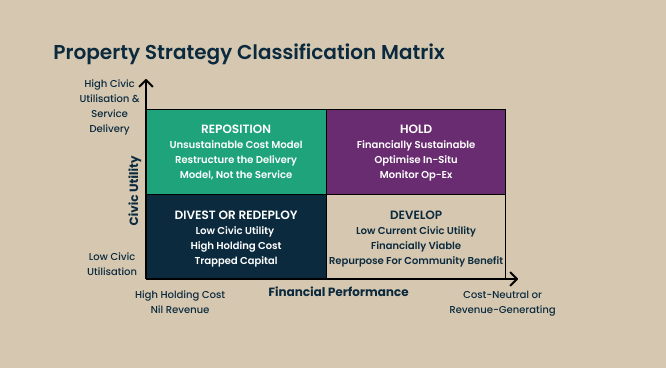
To resolve this dilemma, local governments must establish a clinical definition of a "lazy asset." An asset becomes lazy when it fails to operate at its highest and best use. It is the under-optimised, under-occupied facility that traps municipal equity while failing to meet evolving community needs. Maintaining a lazy asset out of historical sentiment or ideological inertia is not an act of community support. It is a failure of fiduciary stewardship and a compounding opportunity cost.
The sector does not lack strategic frameworks. Many municipalities possess well-designed property strategies detailing assessment tools and explicit mandates to hold, develop, or divest underperforming sites. However, a strategy is a theoretical design. The constraint is execution capacity, not strategic intent.
The moment a clinical "Divest" or "Reposition" decision intersects with a long-standing community organisation, the theoretical strategy stalls under political risk and community friction. Having a property strategy is necessary but not sufficient. Councils require a clinical execution mechanism to enforce it.
If a facility occupies prime land that could otherwise be repurposed to better deliver essential community services across the broader municipality (whether through commercialisation or restructuring via a public-private partnership), protecting the status quo inherently penalises the wider ratepayer base and does not preserve or enhance public value.
The State Mandate: Proactive Positioning or Ceded Authority
Beyond accounting gravity, councils face a material shift in state planning dynamics. The State Government's Housing Statement mandates the delivery of 800,000 new homes over the next decade, heavily targeting established metropolitan Activity Centres.
Through pathways such as the Development Facilitation Program, the Minister for Planning now holds the authority to assume decision-making authority for significant developments, including affordable housing.
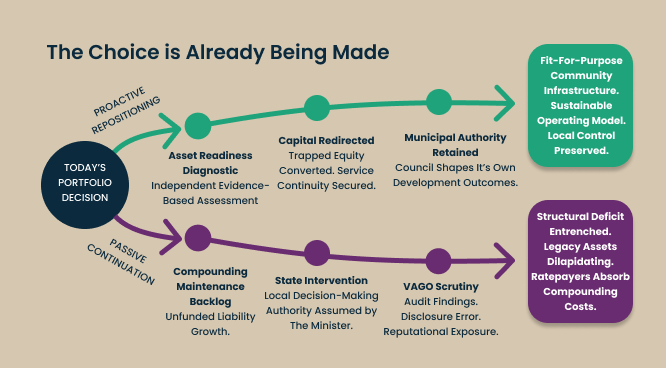
This creates a clear strategic imperative. Activity Centres will be densified, with or without municipal consent. Councils that do not proactively reposition their portfolios in targeted zones cede their role in shaping development outcomes within their own municipality. Conversely, by proactively optimising their portfolios (whether through structuring joint ventures for mixed-use precincts, executing long-term commercial ground leases, or facilitating strategic precinct carve-outs) councils transition from sidelined regulators to empowered market participants. They can generate revenue, create public value, and shape development on their own terms.
Why "Privatisation" Is the Wrong Frame
Resistance to addressing lazy assets frequently stems from a specific framing error: confusing the hardware (the building) with the output (the community service). Risk-averse stakeholders frequently characterise any asset transition as divestment rather than recognising it as the capital recycling mechanism it is.
This framing can paralyse decision-making. Asset repositioning is not a divestment. It is a mechanism that converts trapped equity into catalytic investment, regenerating legacy sites so they deliver a multiplied return in civic value rather than acting as a drain on operational budgets.
True public value is measured by the continuity and quality of the service delivered, not the preservation of the bricks and mortar currently housing it.
The Process Flaw: Why Standard Consultation Stalls
When councils attempt to initiate asset transitions, standard public consultation processes frequently break down. They devolve into forums for unfunded capital aspirations or the airing of historical grievances. The root cause is a fundamental asymmetry in the metrics each party brings to the table.
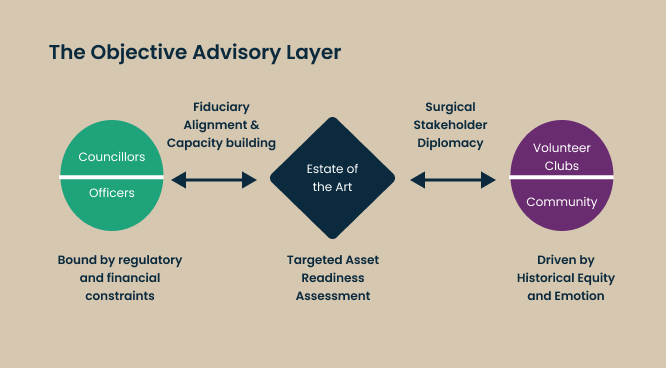
Council officers approach the engagement through the lens of fiduciary sustainability: depreciation schedules, AASB 13 replacement costs, and mandatory safety compliance. Community organisations measure value through service output, historical contribution, and volunteer equity.
The stall occurs because local governments frequently lack a clinical framework to reconcile the cost of the hardware with the value of the service. When a council passively allows a community group to occupy a highly valuable, under-optimised asset at nil rent simply to avoid friction, it creates an opaque financial mechanism. Even where the group's civic value is undeniable, the forgone commercial rent and absorbed holding costs amount to a substantial, hidden subsidy.
If a municipality wrote a direct, multi-million-dollar cash grant to a single, concentrated user group, it would trigger intense ratepayer scrutiny. By inadvertently selecting beneficiaries via free real estate, councils are producing the same outcome off the books. This hidden subsidy sterilises millions of dollars in forgone capital: equity that can be redirected or repurposed to deliver services to the entire municipality.
The strategic question is not whether the volunteer group provides community value (they almost certainly do). The fiduciary question is whether their specific service output justifies the opportunity cost of the real estate they currently occupy, and how their activities can be preserved and enhanced through the transition.
The Principle of Resolution: Surgical Stakeholder Diplomacy
To resolve entrenched asset deadlocks, negotiations must shift from adversarial standoffs to objective capacity assessments. The dedication of community groups is a vital civic asset, but passion alone cannot fund structural depreciation or resolve escalating statutory compliance liabilities.
What councils require is institutional distance to manage this transition.
At Estate of the Art, we execute targeted Asset Readiness Diagnostics through a framework of Surgical Stakeholder Diplomacy. This combined approach provides the separation required to depoliticise negotiations and establish clear, objective pathways forward.
The Asset Readiness Diagnostic is a discreet, fixed-scope engagement. It produces an independent ledger of truth covering site financial performance, community service value, and repositioning options. The output is structured to be tabled at executive level and to withstand scrutiny.
Designed as a discrete, easily commissioned first step, our Diagnostic operates with complete agnosticism. We do not pre-judge the outcome. Instead, we conduct deep local research to evaluate the genuine civic value of the current service while objectively measuring the site's financial and operational realities.
This approach separates the emotional attachment to a legacy building from the objective requirement to provide a sustainable community service. By neutralising political friction and presenting a holistic, data-driven baseline, we empower the executive team to evaluate all operational models with confidence: whether that means retaining the group in situ, co-locating the service, or fundamentally restructuring the asset.
Conclusion
In a highly constrained economic environment, the passive ownership of complex, occupied infrastructure is no longer operationally sustainable for Victorian local governments.
The VAGO data confirms that current internal systems are operating at baseline capacity, with limited headroom for contested portfolio decisions. Contested asset realignments require dedicated institutional capacity that routine municipal systems are not designed to absorb.
The cost of inaction is a compounding structural deficit, the erosion of local decision-making authority through State intervention, and continued VAGO scrutiny. The reward for objective execution extends well beyond a balanced ledger.
Proactive portfolio optimisation is the mechanism to regenerate dormant precincts and bring modern, upgraded facilities to the communities that need them. It empowers the volunteer sector by transitioning community groups into fit-for-purpose operating models. The goal of asset repositioning is not to abandon the community's legacy. It is to secure the community's future.
To initiate an Asset Readiness Diagnostic for your municipality, contact Estate of the Art for a confidential briefing. The Diagnostic is structured to produce documentation suitable for tabling at council meetings.
