


Subsidised rent is not free rent. It is a grant, renewed every year, usually without a grants process.
Somewhere in your municipality, a well-located building is occupied for one dollar a year. Nobody can say what it would rent for on the open market. Nobody has asked in a decade. The arrangement predates everyone in the room.
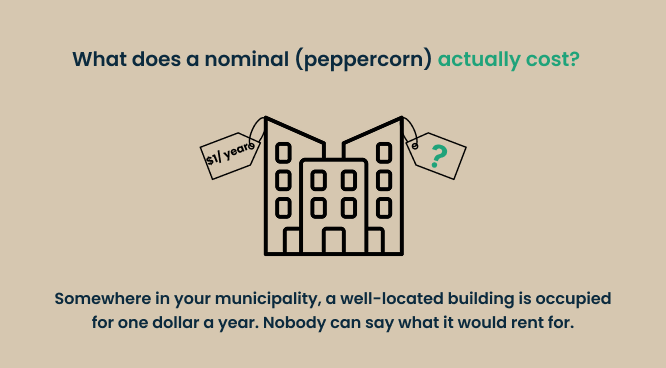
This is not an anomaly. Across Victorian local government, community occupancy portfolios sometimes run to hundreds of tenancies per municipality: sporting pavilions, community halls, kindergartens, club rooms, and offices occupied by service providers. A large share sit on peppercorn, or heavily discounted rents. Almost none carry a visible price tag.
That price tag exists. It is simply not recorded anywhere.
An invisible grant, renewed annually
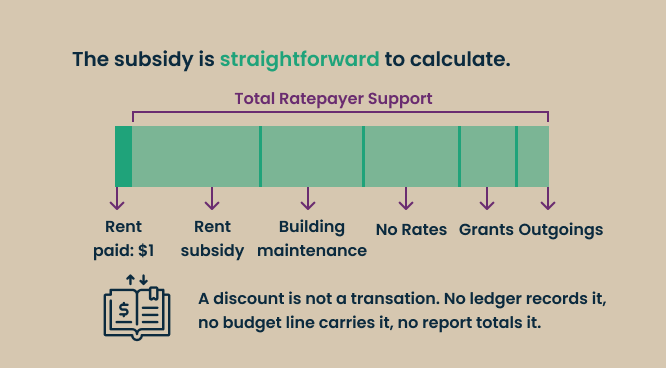
The arithmetic is not complicated. The subsidy in any occupancy is the gap between the rent the property would command on the open market and the rent actually paid. If a facility would achieve an assessed market rental of $40,000 a year and is occupied for a peppercorn, the council is granting $40,000 of ratepayer support to that occupant, every year. (The figures here are illustrative)
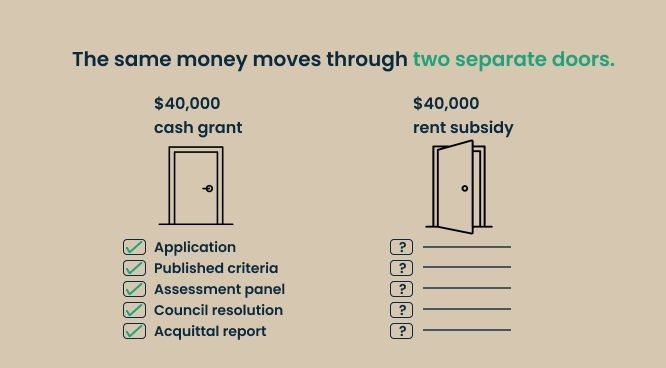
Compare the governance around that grant with the governance around a cash grant of the same size. A $40,000 community grant typically requires an application, published criteria, an assessment panel, a council resolution and acquittal reporting. The property subsidy of identical value often requires none of these. It flows because it always has.
The same public money, moving through two doors. One door has a lock, a logbook and a light on. The other has been propped open since the 1980s.
Why the number is missing
It is important to stress this is not a failure of diligence by property teams.
It is a structural blind spot, and it has three causes.
First, forgone revenue does not appear in the accounts. A discount is not a transaction. No ledger records it, no budget line carries it, and no report totals it. What is never recorded or measured is never questioned.
Second, community facilities rarely carry market rental assessments, for a number of reasons. Valuations are commissioned for disposals and commercial lettings, not for the pavilion that has housed the same cricket or tennis club for 40 years.
Without a process for assessing market rent, or using a robust methodology to establish a suitable proxy for it, the subsidy cannot be calculated even by someone who wants to.
Third, the impacts build up over time. Tenancies roll over, expired agreements stay in place, and each arrangement on its own looks too small to bother with. It is only when you add them all up that the number matters. In our experience, when a council totals the ratepayer support across its whole portfolio for the first time, the figure runs to millions a year. It almost always comes as a surprise.
Visibility is not recovery
Here is where most conversations about peppercorn rents go wrong, and why many councils quietly avoid having them.
The fear is that quantifying the subsidy is the first step towards charging a local not-for-profit a market rent. It is not; and it must not be framed that way. The purpose of making ratepayer support visible is not to withdraw it. It is to make it deliberate.
Most community occupancies will in fact, justify a subsidy comfortably. A club that maintains a facility, delivers participation outcomes and serves residents may well warrant every dollar of support it receives, and more. Making the subsidy visible lets the council say so, on the record, with evidence.
What visibility actually changes is the question. "What have we always charged?" becomes "what support has this occupancy earned?" That question is answerable through a criteria-based subsidy structure: tiers of support linked to demonstrated community benefit, applied consistently across the portfolio. Occupants know where they stand and why. Councillors can defend any individual arrangement because the same logic governs all of them.
A municipality may have several hundred well established community organisations who could in theory be potential occupiers of Council owned property. It is only fair that when selecting the recipient, the benefit to the organisation, and to the wider community from the organisations activities is measured.
The question is coming, whether or not the answer is ready
The Local Government Act 2020 asks councils to plan financially over the long term and to be transparent in decisions about public resources. Auditors and councillors are increasingly literate in asset questions. Community expectations about how public property is allocated are rising, not falling.
Which means the question arrives eventually, in a chamber, an audit or a budget workshop: how much ratepayer support flows through our property portfolio, and who decided who gets this support? A council with a quantified, categorised, policy-backed answer controls that conversation. A council without one is defending arrangements it cannot explain, one aggrieved comparison at a time. The occupant paying $10,000 will always find the occupant paying one dollar.
Where to start?
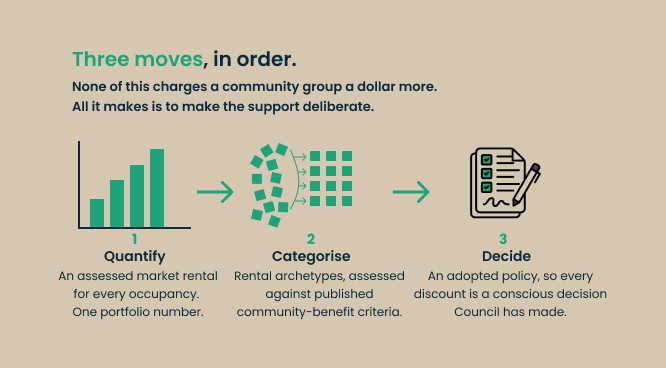
Three moves, in order.
Quantify
Establish an assessed market rental (or suitable proxy) for every occupancy and total the gap. One number: annual ratepayer support across the portfolio. This is the step most councils have never taken, and it changes the conversation immediately.
Categorise
Group occupancies into archetypes and assess each against published community-benefit criteria. Like cases treated alike; unlike cases distinguished on the record.
Decide
Adopt the policy that links tier to subsidy, so that every discount is a decision the council has made rather than an arrangement it has inherited.
None of this requires charging a community group a dollar more. All of it requires knowing what is currently being granted, to whom, and why. That knowledge is the difference between a subsidy programme and a blind spot.
A peppercorn is a perfectly defensible rent. But only once you know what it costs.
Estate of the Art advises Victorian councils on occupancy frameworks, rent and subsidy architecture, and lease and licence policy. If your occupancy portfolio has never been totalled, that is the place to begin.
